
Ask A Librarian

Marian Bustin’s Deportation Investigation 

Posted by Admin.
March 24th, 2026

By Abigail Moncus, West Virginia Feminist Activist Collection Project Archivist 

In the National Organization for Women, West Virginia and Morgantown Chapters Records, a wide range of materials document the activities and functions of NOW in West Virginia. Most relate to the internal functions of the various chapters and their productive outputs, including meeting minutes, newsletters and various ephemera. However, the collection also contains occasional instances of material created by other organizations operating in the Morgantown area, such as a pamphlet created by the local Socialist Workers Party expressing support for coal miner Marian Bustin, who was facing deportation for her socialist activities.  
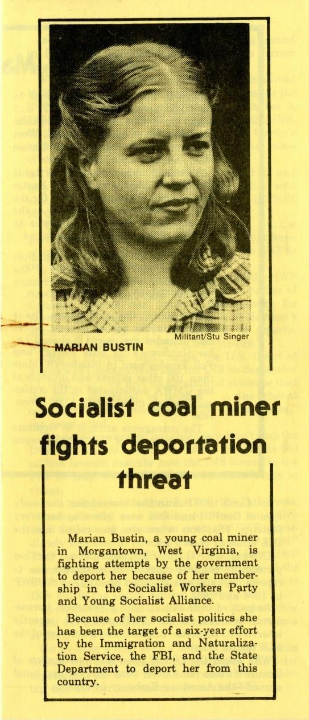
A pamphlet, featuring writing from The Militant, in support of Marian Bustin (Socialist Coal Miner, undated, Box 2, Folder 57, National Organization for Women, West Virginia and Morgantown Chapters, Records, A&M 3247, West Virginia and Regional History Center, West Virginia University Libraries, Morgantown, West Virginia.) 

While living in Morgantown, West Virginia, and working in Republic Steel Kitt No. 1 Mine, Bustin came to the attention of authorities in late 1980 when the United States Immigration and Naturalization Service (INS) and Federal Bureau of Investigation (FBI) attempted to deport her for her membership in the Socialist Workers Party (SWP) and Young Socialist Alliance (YSA).  

Marian Bustin, born Marian Margaret Carr to a working-class family in Scotland in 1954, was active in social activism from an early age. She reported participating in Glasgow’s Women in Action and Indo-China Committee, as well as England’s International Marxist Group.1 

While visiting the United States from June 1974 to January 1975, Bustin (then Blackburn, after her first husband) maintained membership with the Lower Manhattan Branch of the Socialist Workers Party in New York and reportedlyattended “six SWP-related meetings.”2 

After returning to Scotland, she married American citizen Andrew Bustin and moved permanently to the United States, first to New York, and later to Morgantown, West Virginia, following her separation from her second husband. Unbeknownst to Marian Bustin, at the time of her residential move to the U.S. in 1977, the U.S. embassy in London reported her as a socialist to the INS, leading the New York INS office to open an investigation. 

This investigation followed her to Morgantown, where the INS coordinated with the Pittsburgh FBI and West Virginia State Police for any updates on her case. In early 1979, she became aware of this investigation when INS inspector Godfrey England reported to her that her “permanent resident status was in danger due to reports that she had attended meetings of the SWP in 1974 and 1975.”3  

Her case gained public attention in 1980 after lawyers of the SWP and YSA obtained her INS and FBI files while working on a lawsuit against the U.S. government. At the time, she was a member of United Mine Workers Local 2095 and active with the Morgantown chapter of the Coalition Against Registration and the Draft. 

Bustin’s case was quickly taken on by the Morgantown SWP and YSA. On Oct. 31, 1980, Bustin made her first appearance in a press conference alongside Tom Moriarty, the 1980 Socialist Workers candidate for West Virginia governor, criticizing the government campaign against her, which aired on WCHS, WCAW radio, and WCHS-TV.4 
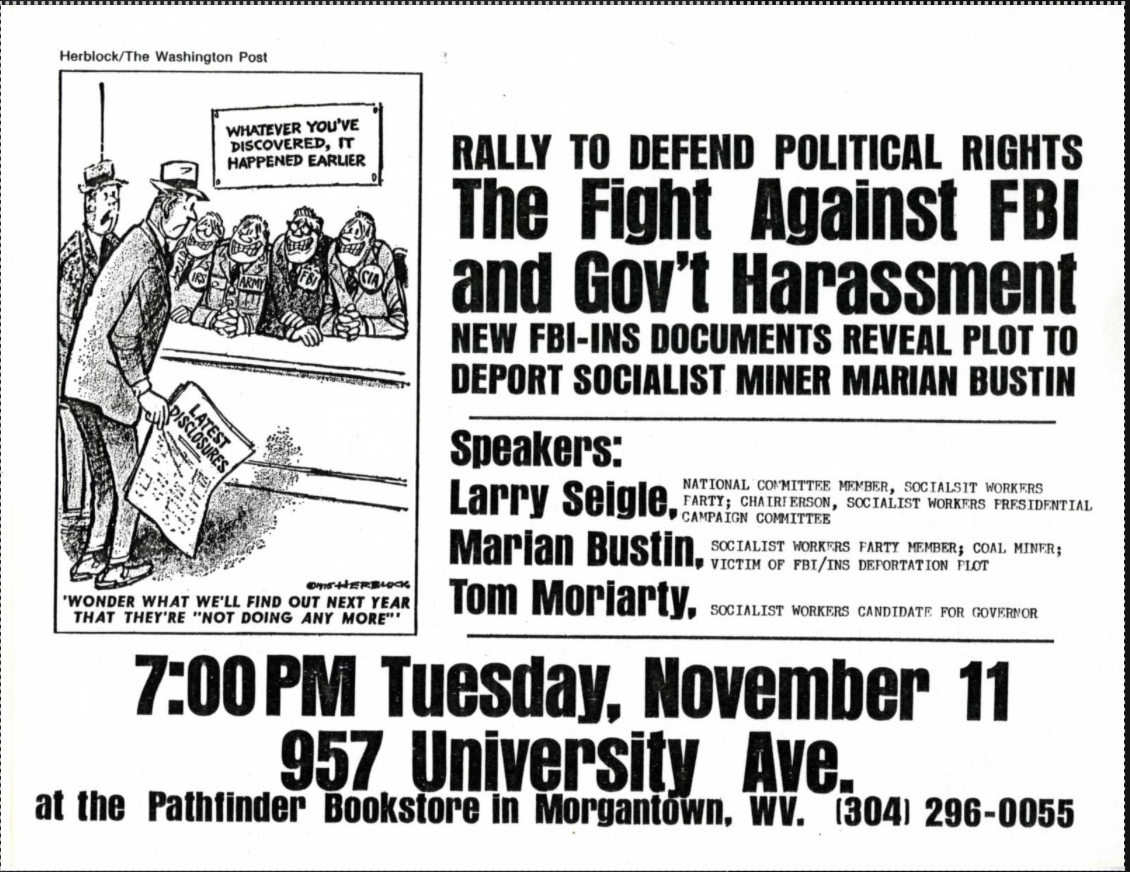
 
A flyer promoting a rally supporting Marian Bustin in Morgantown, 1980 November (Government Harassment Rally, undated, Box 2, Folder 54,  National Organization for Women, West Virginia and Morgantown Chapters, Records, A&M 3247, West Virginia and Regional History Center, West Virginia University Libraries, Morgantown, West Virginia.) 

A campaign was also launched in her defense. The first rally took place Nov. 11, 1980, at the former Pathfinder Bookstore at 957 University Ave. in Morgantown. Speakers included Bustin and Moriarty, along with Larry Seigle, a national committee member of the Socialist Workers Party, and Hector Marroquin, a fellow party member also facing deportation threats. 
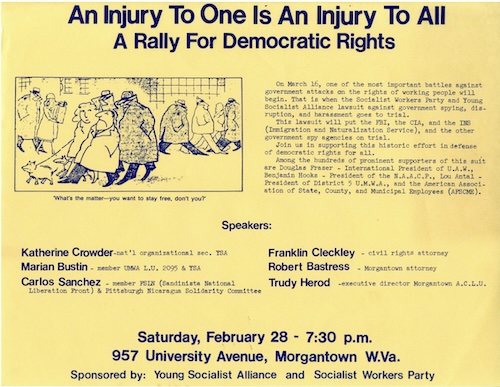
A flyer promoting a rally supporting Marian Bustin in Morgantown, 1981 February (Democratic Rights Rally, undated, Box 2, Folder 54, National Organization for Women, West Virginia and Morgantown Chapters, Records, A&M 3247, West Virginia and Regional History Center, West Virginia University Libraries, Morgantown, West Virginia.)

Another rally was held Feb. 28, 1981. Speakers included Bustin, YSA secretary Katherine Crowder, civil rights attorney Franklin Cleckley, Morgantown attorney Robert Bastress, Sandinista National Liberation Front member Carlos Sanchez, and Morgantown ACLU director Trudy Herod.  

The pamphlet mentioned earlier in this article likely entered the NOW records after Bustin attended a Morgantown NOW meeting to promote this 1981 rally. Misidentified as “Maureen Buston,” she spoke at this meeting, but NOW members did not take action on sending a speaker to the rally.  
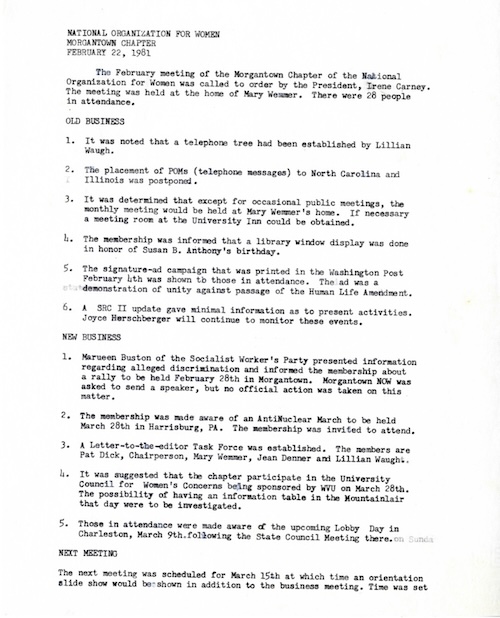
Minutes from the Morgantown Chapter of the National Organization for Women, featuring “Maureen Buston” as a speaker, 1981 February 22 (Chapter Minutes, 1981 February 22, Box 2, Folder 72,  National Organization for Women, West Virginia and Morgantown Chapters, Records, A&M 3247, West Virginia and Regional History Center, West Virginia University Libraries, Morgantown, West Virginia.) 

In April 1981, Bustin and Marroquin testified about the deportation threats in the Socialist Workers Party v. Attorney General of the United States.5 After several years, the SWP was awarded $264,000 in damages relating to disruptive activities, surreptitious entries, and the use of informants.6 

In the months following public exposure of her case, Bustin traveled as a speaker for the Political Rights Defund Fund, visiting Wisconsin, New York, Pennsylvania, Illinois, and southern West Virginia. As attention on her case died down, she presumably returned to her normal activities.  

In the following years, she continued her socialist activitism, writing several articles for The Militant, including “District 17 miners rally to protest nonunion coal” (May 29, 1981), “Miners speak about safety cuts” (March 26, 1982), “Toledo abortion clinic bombed” (July 13, 1986), and “Toledo rally protests abortion-clinic bombing” (July 18, 1986). 

Tracing Bustin’s life after the 1980s is difficult due to her limited public presence. However, available evidence suggests she relocated to Ohio before 1986, and later to Iowa around 1988, based on occasional references in The Militant. She appears to have continued a career working in various labor jobs.  

The lack of reporting on her case suggests she was never deported. 

Materials regarding Marian Bustin and other related activities can be found in the National Organization for Women Records at the West Virginia and Regional History Center.  
This project is made possible with support from the National Historic Publications and Records Commission. 

References: 

1. Vivian Sahner, “The story of Marian Bustin,” The Militant 44, No. 42 (1980): 12.  

2. Investigative Summary, 1974, Box 2, Folder 57, National Organization for Women, West Virginia and Morgantown Chapter, Records, A&M 3247, West Virginia and Regional History Center, West Virginia University Libraries, Morgantown, West Virginia. 

3. Vivian Sahner, “Gov’t threatens to deport socialist miner,” The Militant 44, No. 39 (1980): 6.  

4. “Radio, TV cover Bustin case,” The Militant 44, No. 42 (1980): 12. 

5. Vivian Sahner, “Trail witnesses to document gov’t harassment,” The Militant 45, No. 12 (1981): 3. 

6. Socialist Workers Party v. Attorney General of the United States, 642 F.Supp. 1357 (S.D.N.Y.1986). 
Staff Favorites from the WVRHC Collections | Part 2

Posted by Admin.
March 23rd, 2026

By Samatha Wade, WVRHC Graduate Assistant 

In trying to promote pieces of the West Virginia & Regional History Center’s collections, I began curating staff favorites to share. Part 1 of staff favorites included some of the staff’s responses and only a small portion of the WVRHC’s collections. The following is a continuation of histories from the WVRHC’s collections.

Deakins Surveying Compass – Catherine Rakowski, Research & Exhibition Specialist

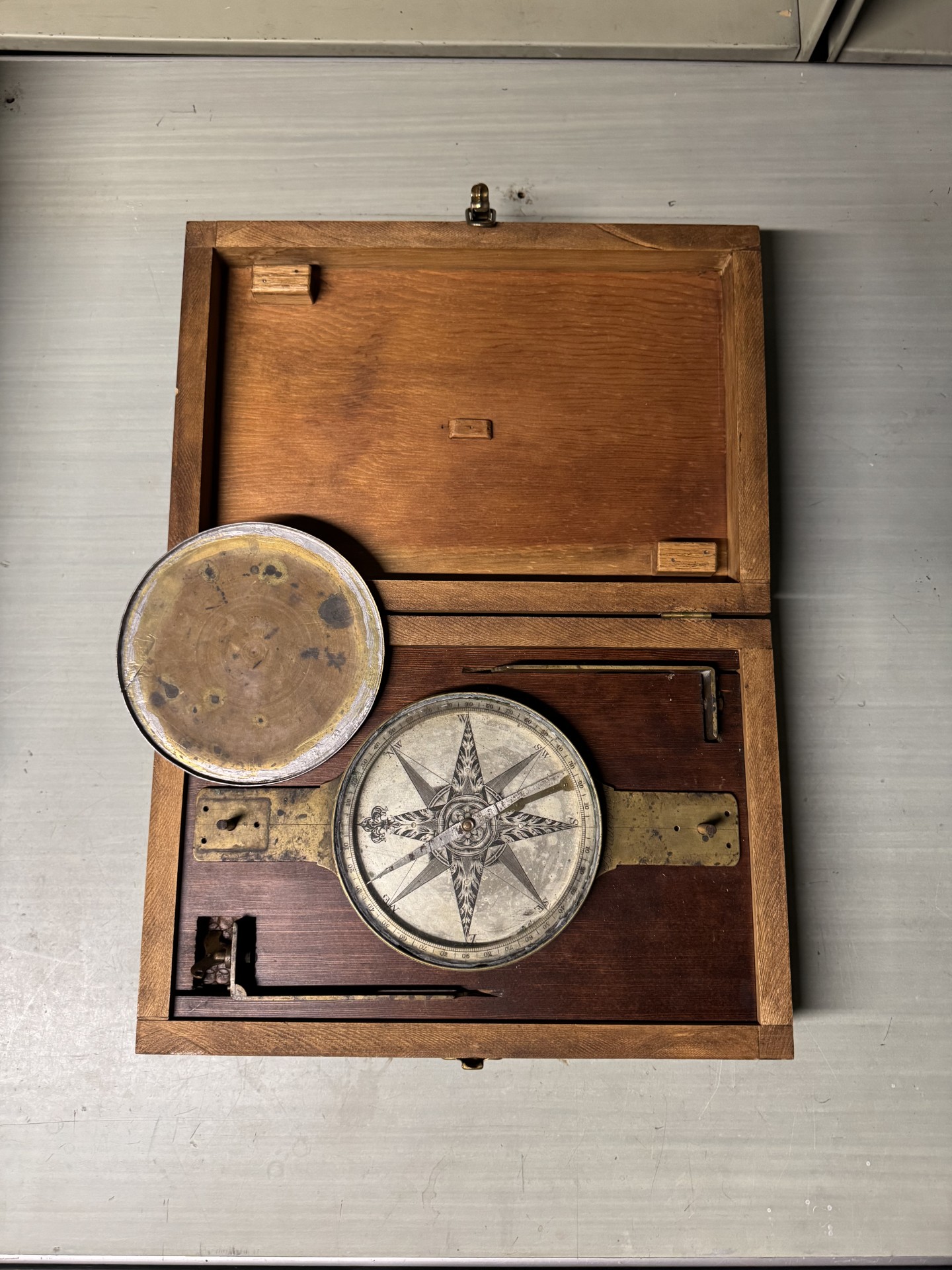
The WVRHC has an eighteenth-century surveying compass used by Francis Deakins to survey the “Deakins Line,” a north-south line separating eastern Maryland from (West) Virginia in 1787-88.

A&M 0197, Francis Deakins’ surveying compass

Colonists began moving westward soon after their arrival on the east coast of North America. With this came boundary disputes between colonies and later states. To clearly define the boundary between Pennsylvania and Virginia, two surveyors were employed to find and mark this boundary. The result was the Mason-Dixon Line, named after the surveyors Charles Mason and Jeremiah Dixon. Even then, the issue was not completely resolved because Maryland’s boundary was also being disputed.

Francis Deakin was employed to survey the western boundary of Maryland. Unfortunately, it would later be determined that the Deakins line was inaccurate. Maryland’s western borders continued to be an issue with West Virginia after the Civil War and into the early 1900s. The Deakins Family Papers and Surveying Compass collection (A&M 0197) includes deeds, agreements, surveys, plats, surveyors’ field books, court papers, and letters that document the activities of Francis Deakins and his brother William.

Stick from the stretcher used to carry Stonewall Jackson – Jane LaBarbara, Head of Archives and Manuscripts

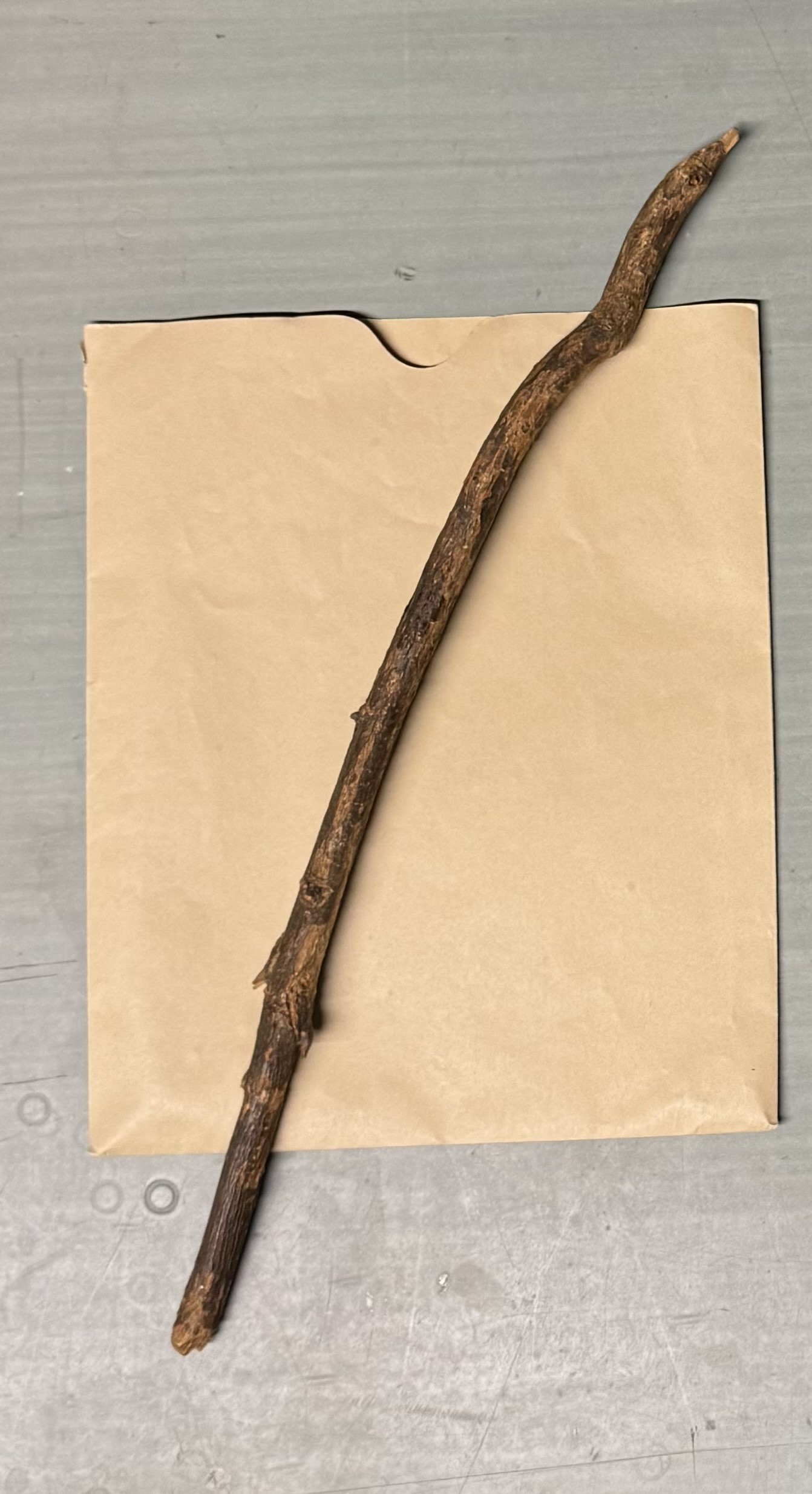
Another piece in WVRHC’s collections is a stick from the stretcher that was used to carry Thomas “Stonewall” Jackson, a Confederate general, when he was mortally wounded by his own men in 1863 (A&M 1561).

A&M 1561: Stick from the stretcher used to carry Jackson off the battlefield  

Jackson had taken a group of men to scout out a wooded area when they were mistaken as the enemy by a North Carolina regiment. The regiment opened fire, and Jackson was shot in an area around his left shoulder. He was carried from the field to a nearby plantation where he had his arm amputated. While recovering, Jackson came down with pneumonia and died on May 10, 1863. The stick is part of the Roy Bird Cook Collection (A&M 1561).

Cook was a pharmacist and local historian with a great interest in the Civil War. His collection includes correspondence and other materials relating to Jackson.

The Metropolitan Theatre, Morgantown, Records Cat Melillo, Archives Processing Assistant

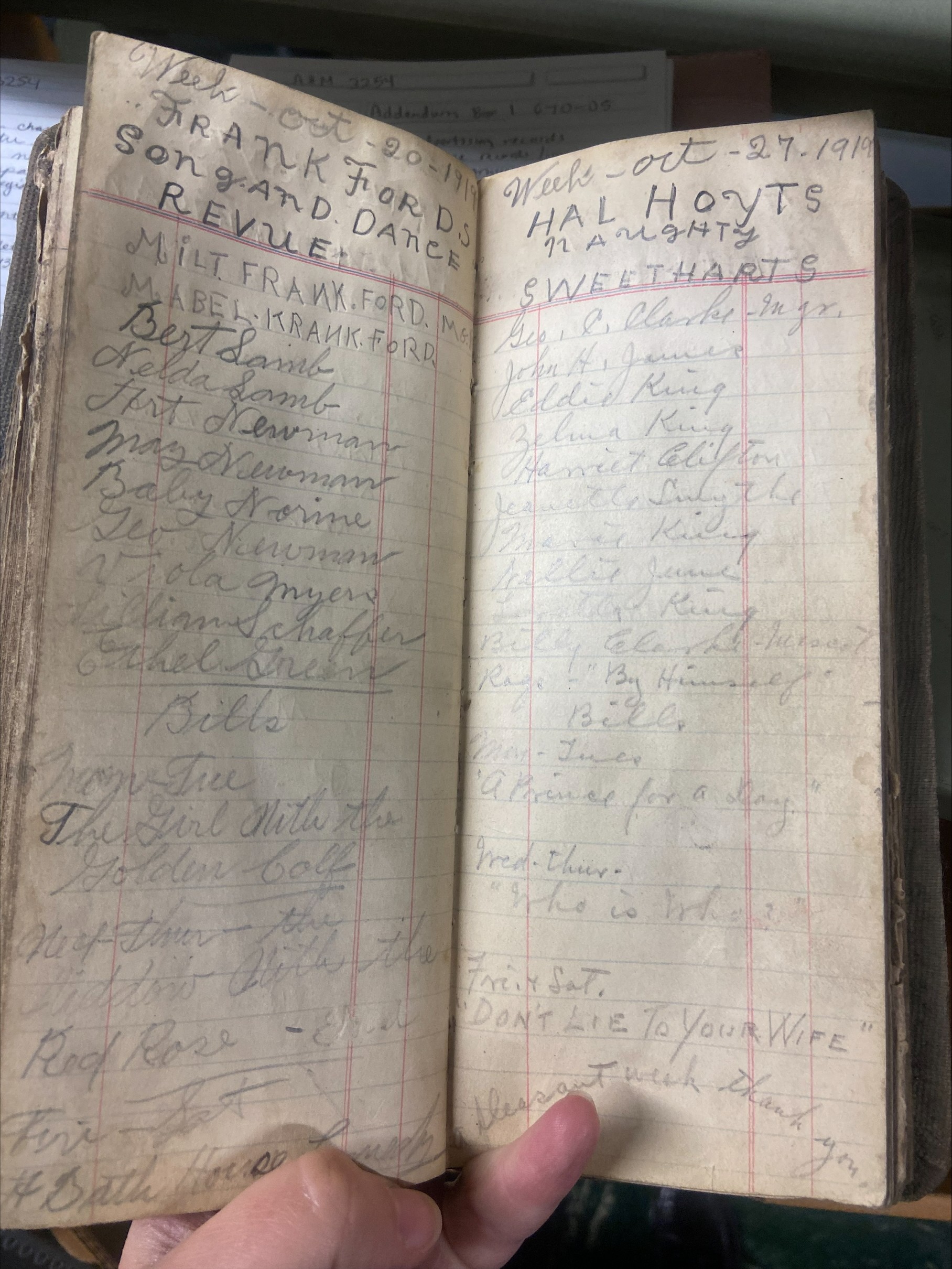
The Metropolitan Theatre, Morgantown, Records (A&M 3254) contains ninety years of records documenting the history of the Metropolitan Theatre and other respected local arts institutions, including the Strand Theatre, Morgan Theatre, Morgantown Theatre Company, Morgantown Amusement Company, and the Westover Drive-In. Maybe the most interesting items from this collection are the early 20th century stage manager logbooks containing lists of which touring vaudeville acts performed there on each date. The titles and descriptions of the acts become less vaudeville and more burlesque sounding into the 1920s.

A&M 3254: Stage manager logbook from 1919

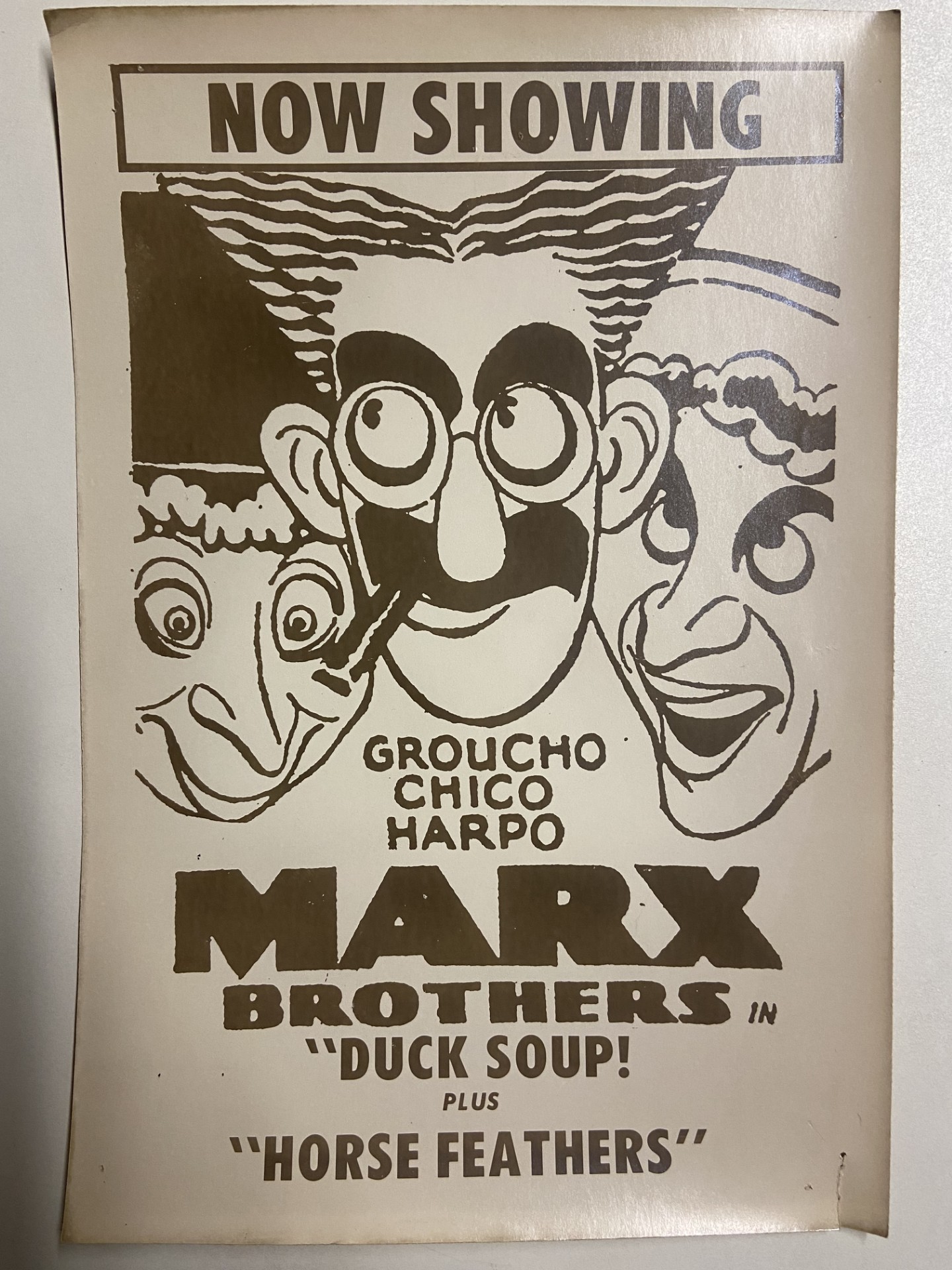
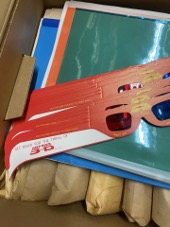
In the last Staff Favorites blog, one of the histories shared was about Russell L. Long, who had an interest and involvement in local vaudeville acts. He even got his start at the Dixy Theatre in Morgantown on High Street. The Dixy Theater seems to have been where Reiner & Core was located in the 1960s and what is now Almost Heaven Bar and Grill. The collection also has cool movie posters, such as one for a musical comedy Duck Soup from 1933, and 1970s 3-D glasses!

A&M 3254:  Movie poster for Duck Soup from 1933 
A&M 3254:  1970s 3-D glasses 

Staff Favorites from the WVRHC Collections | Part 1

Posted by Admin.
March 12th, 2026

By Samatha Wade, WVRHC Graduate Assistant

The West Virginia & Regional History Center (WVRHC) holds many interesting artifacts and manuscripts within its collections. I tried finding interesting items myself, but because the collection is so large, it proved overwhelming. Instead, I turned to staff members here at the WVRHC who work with the collections every day in different ways and asked them to share their favorite item. The following histories are the result.

“Impersonator Russell L. Long, High Street, Morgantown, W. Va”- Lemley Mullett, Digital Collections Archivist

Census records for Morgantown documented Russell L. Long’s birthplace in Pennsylvania, 1889. By 1915, Long was living in Morgantown working as a glass worker. He was also a local impersonator.

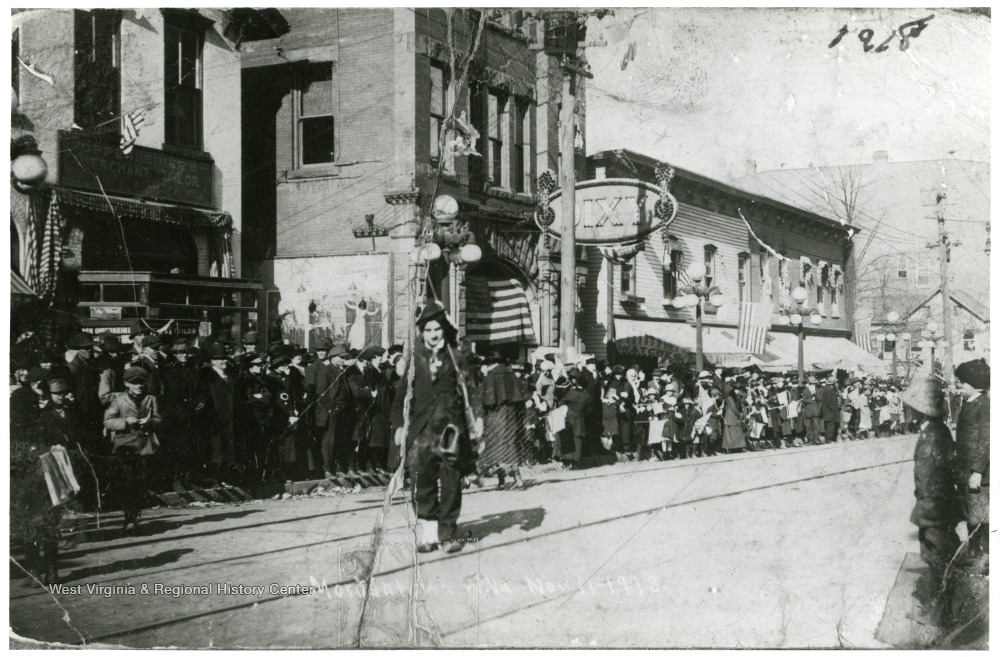
A photo taken in 1918 during a Labor Day Parade shows Long dressed as Charlie Chaplin. It’s on this photo Long wrote his “first impersonating of Chaplin was with the Dixy Theater on Hight Street.”

Russell L. Long Impersonating Charlie Chaplin in Morgantown, W. Va.” in street parade

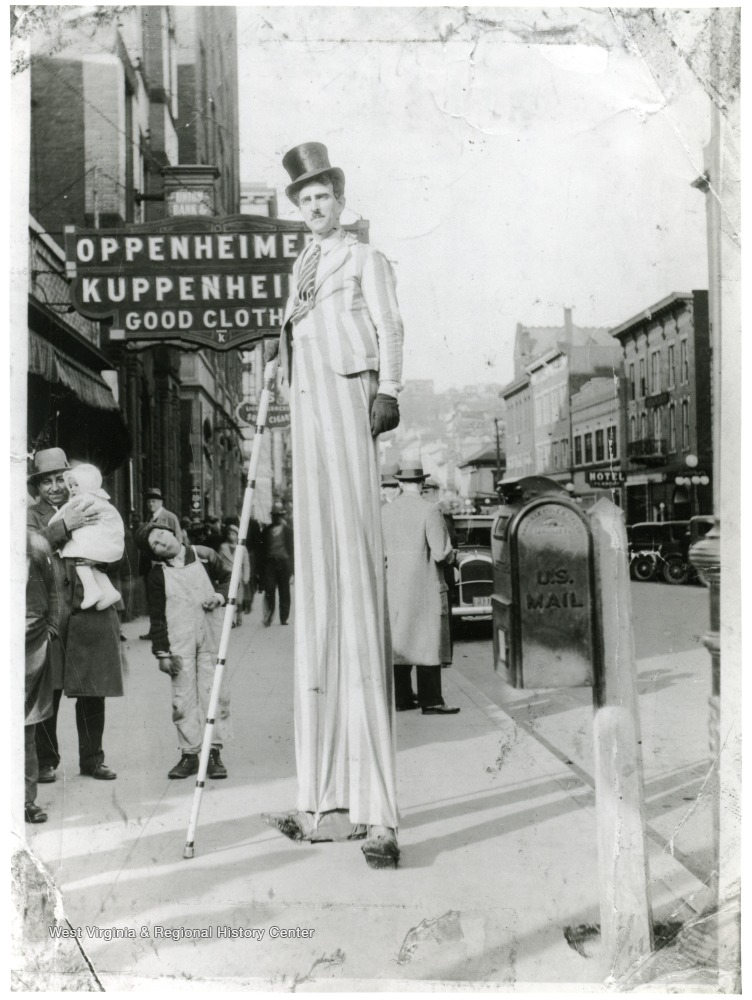
Lemley chose to show the photo below, where he was dressed as Charlie Chaplin on stilts. This photo is dated 1933, standing outside Oppenheimer’s Kuppenheimer Good Clothes store, a popular brand in the 1920s. Long wrote, “My construction of my stilt and the foot pivot is my own invention and makes it possible for me to move with comparative ease being a mechanical tall-man the hours I perform on them.” Long was on these stilts for 3-4 hours. In 1948, Russell L. Long portrayed Charlie Chaplin in the Morgantown Labor Day parade.

Russell L. Long on Stilts in Morgantown, W. Va.

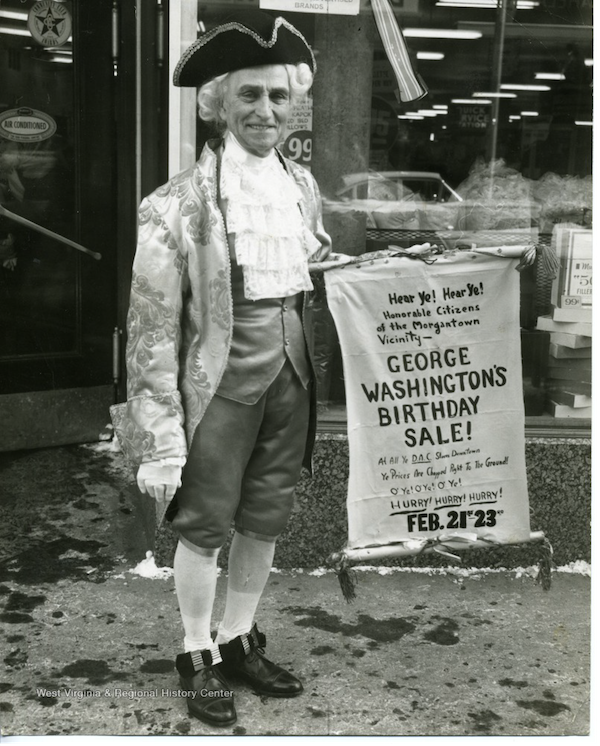
In 1967 he “donned the garb of the Revolutionary period and paraded the city streets” in honor of George Washington’s birthday sale sponsored in Morgantown. Long died in Morgantown, 1972.

Russell L. Long Portraying George Washington.

Pickaxe and Auger – Bridget Jamison, Instruction and Public Services Archivist

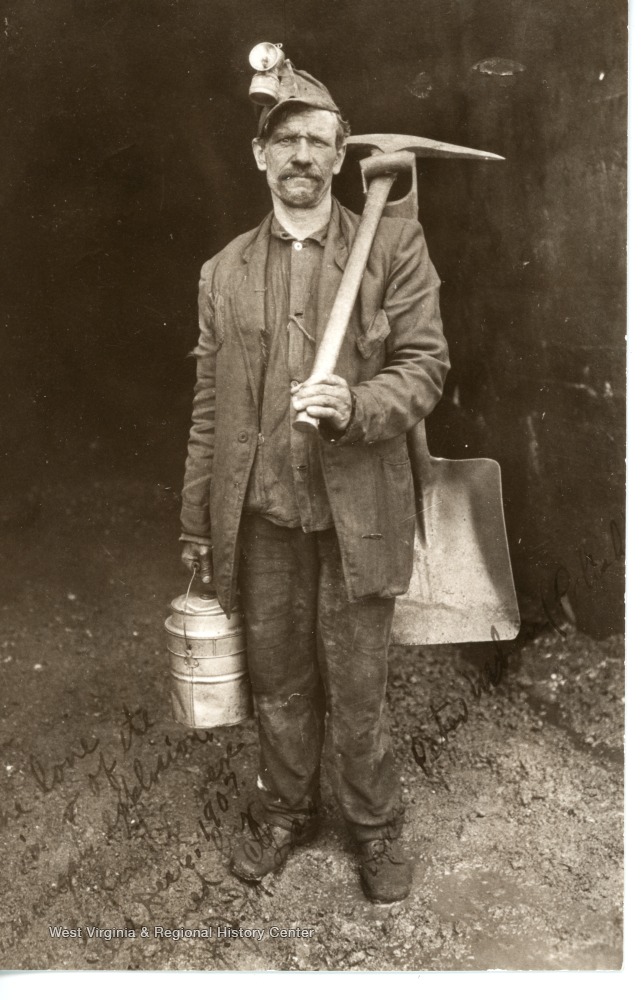
Coal miners are a prominent part of West Virginia history, and the WVRHC houses numerous collections relating to coal mines, mining, and coal miners. The J. Davitt McAteer Papers regarding Mining Safety collection includes mining tools. Among them is an auger and pickaxe.

“Coal Miner” with his pickaxe, shovel, and canister from A&M 4520

Coal mining in West Virginia can be recorded as early as 1810 at a mine near Wheeling. The industry grew with the introduction of railroads. In 1940, West Virginia reached peak employment in mines. In this same decade, auger mining, a surface mining method, was introduced.

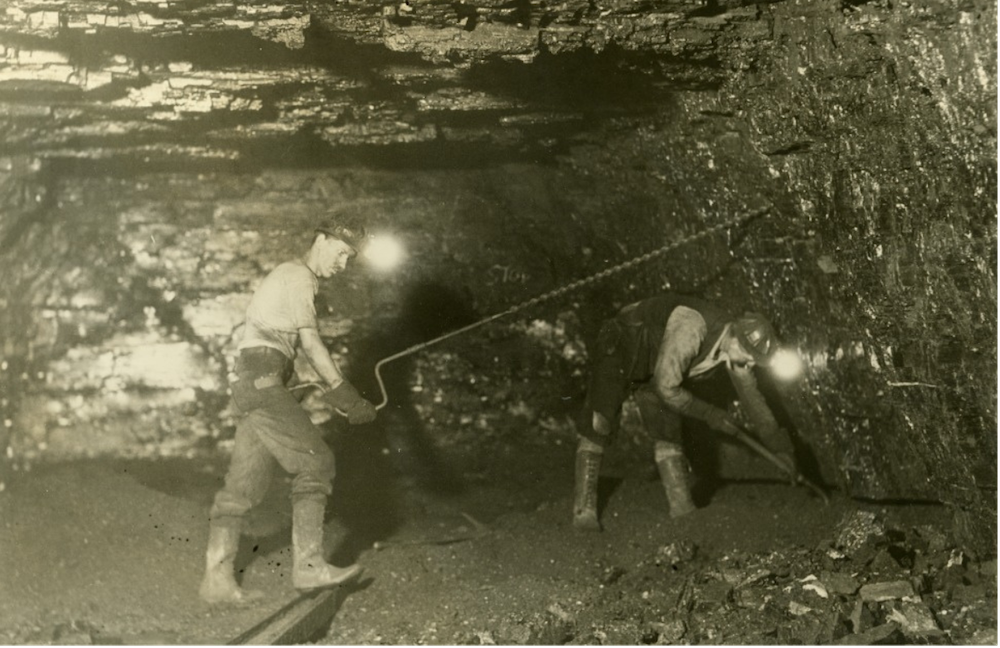
“Coal Miners at Work” from A&M 3649

Handheld augers, like the one shown above, are used to drill into a coal seam and extract coal on the screw bit. Before this, however, pickaxes were the most common tool used in mining to break up and excavate coal. While modern machinery and legislation have advanced mining, the mining profession remains dangerous.

A collection of English proverbs, digested into a convenient method for the speedy finding any one upon occasion, John Ray,1678 – Rigby Philips, Rare Book & Print Collections Archivist

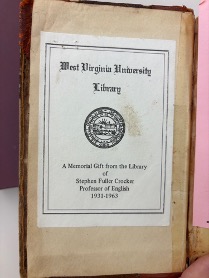
Bookplate in a WVRHC Rare Book collection of English proverbs written by John Ray, 1968.

The book features English proverbs like “Be not a baker if your head be of butter” and “It’s easie to bowl downhill.” These are only a sample of the funny lines found in the book. John Ray, educated at the University of Cambridge, was a Fellow of the Royal Society and known for his work in botany, zoology, and natural theology. The copy in the WVRHC’s collection is a memorial gift from the library of Stephen Fuller Crocker. Crocker was a professor of English at WVU from 1931 to 1963, and a native West Virginian born in Wheeling, 1898. He passed not long after he retired in 1969.